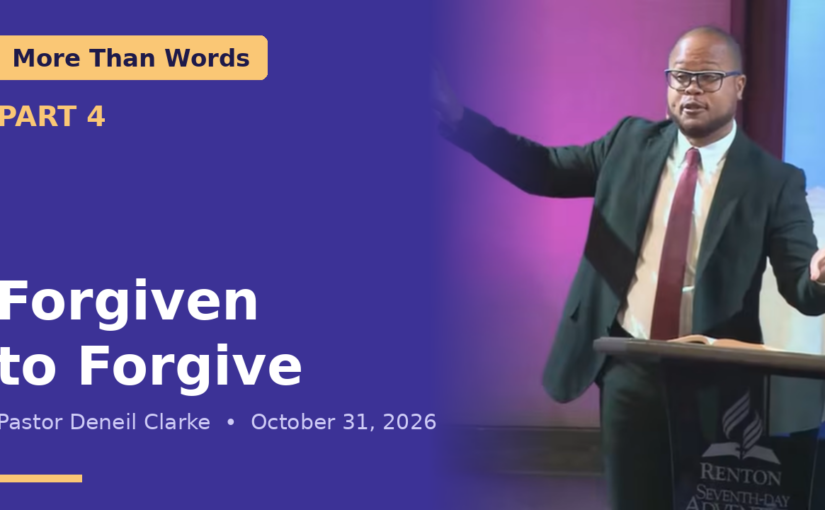
This Sabbath, Pastor Deneil Clarke took us to the line in the Lord’s Prayer that many of us find hardest to pray: “Forgive us our debts, as we forgive our debtors” (Matthew 6:12).
Big idea: God’s forgiveness is a gift we can’t earn, and it gives us the power to forgive others.
Key takeaways:
Walk by your calling, not your feelings. Paul tells us to “walk in a manner worthy of your calling” (Ephesians 4:1). Our feelings change from day to day. Our calling to live in peace does not.
We can’t pay for forgiveness. Pastor Clarke pointed out that many people in Martin Luther’s day saw forgiveness as something you could buy. But forgiveness isn’t a trade. It comes only from God’s grace.
Forgiveness makes us new. God promises to “take out the heart of stone” and give us “a heart of flesh” (Ezekiel 36:26). In Christ, “all things have become new” (2 Corinthians 5:17).
Forgiving isn’t the same as excusing. It doesn’t mean pretending the hurt wasn’t real. It means letting go of bitterness and the desire for the other person to suffer.
We don’t do it on our own strength. God is “able to do far more abundantly than all we ask or imagine” (Ephesians 3:20). The power to forgive comes from Him, not from trying harder.
The illustration that stuck with us:
Pastor Clarke asked us to picture digging our hands into mud and squeezing it tight. Then we go to the sink, turn on the water, and pump soap on our hands, all while keeping our fists closed. We want clean hands, but we won’t let go of the mess. Holding on to bitterness works the same way. God wants to clean us up, but first we have to open our hands.
He also reminded us that when Peter asked if forgiving someone seven times was enough, Jesus said “seventy times seven” (Matthew 18:22). Somewhere past 50, you lose count. Forgiveness stops being something we keep score of and becomes part of who we are.
Something to think about this week:
When a certain name comes up, how does your heart react? Is there something you’re still holding on to that you could give to God?